
IP67 vs IP65 LED Driver: Which Rating Do You Need?
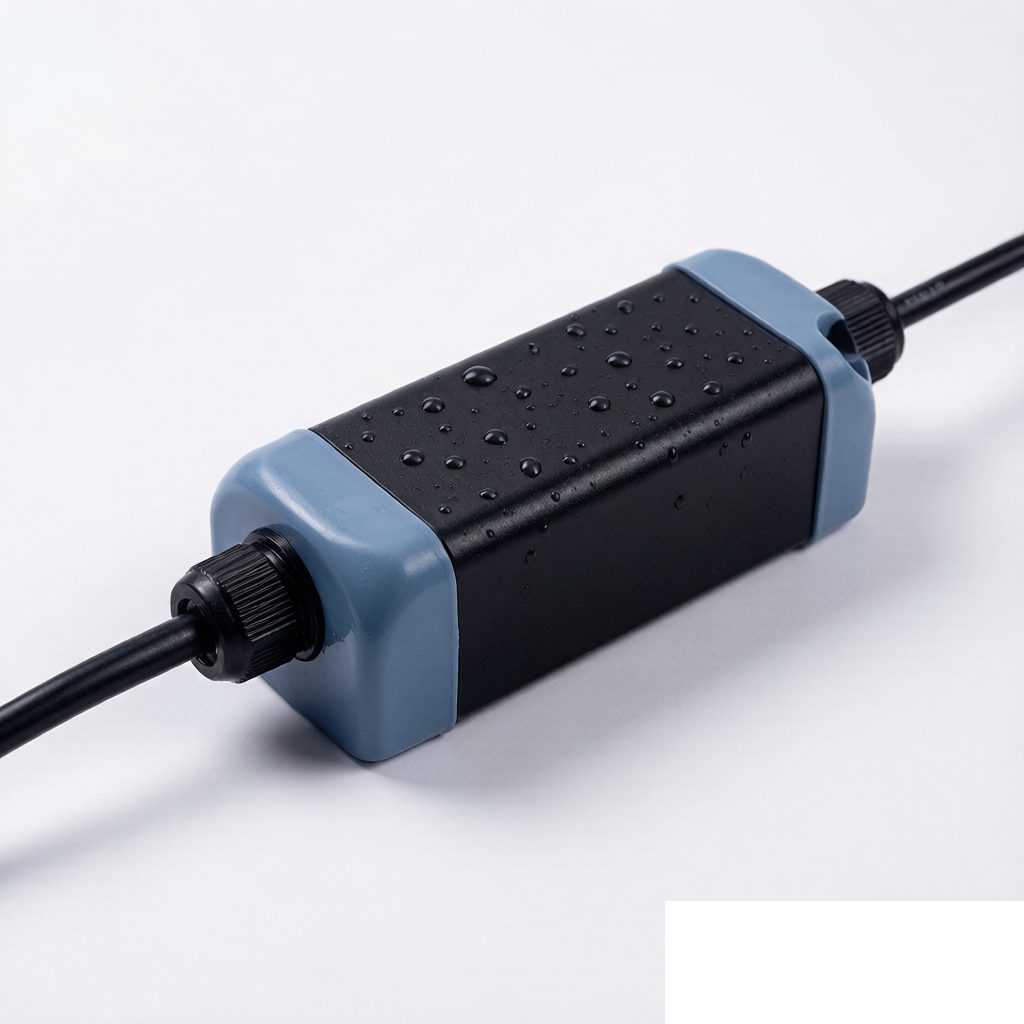
"Waterproof" is not one specification — it is a test result. An IP65 driver and an IP67 driver look nearly identical on a datasheet, but they survive very different jobs, and picking the wrong one is the single most common cause of early outdoor failures we see in the field.
This guide breaks down what each rating actually protects against, where each one stops working, and how to decide — without paying for protection you do not need.
What the two digits mean
Every IP code has two digits. The first is solids (dust), the second is liquids (water). For LED drivers the first digit is almost always 6, meaning dust-tight. So the real difference lives in the second digit.
| Code | Test it must pass | What it survives |
|---|---|---|
| IP65 | 6.3 mm water jet from any direction, 3 minutes | Rain, splashing, hose-down from a distance, dust |
| IP67 | Immersion in 1 m of water for 30 minutes | Temporary flooding, standing water, wash-down, salt spray |
| IP68 | Continuous immersion, depth agreed with the maker | Fountains, pools, in-ground wells |
Where IP65 is the right call
IP65 is the value choice whenever the driver is exposed to weather but never sits in water:
- Signage and channel letters — the driver lives inside a sealed sign box.
- Billboards and light boxes — rain runs off the housing, nothing pools.
- Covered walkways, canopies, semi-outdoor ceilings — damp and dusty, but dry.
- High power, 100-600W — the vented metal case sheds heat far better than a sealed potted unit, which is exactly why this line reaches 600W.
If your install is any of the above, our IP65 rainproof drivers cost less and run cooler than a potted equivalent. Paying for IP67 here buys you nothing but a hotter driver.
Where you must step up to IP67
Choose a fully potted IP67 waterproof driver when water can collect around the enclosure or the air itself is aggressive:
- Ground-level or in-ground installs — garden lights, path lighting, bollards that flood after heavy rain.
- Fountains, pools, water features — splashes and temporary immersion are routine, not accidents.
- Coastal and marine sites — salt spray corrodes a vented metal case from the inside out; silicone potting plus a salt-spray test is the only durable answer.
- Wash-down areas — food processing, car washes, tunnels that get hosed regularly.
- Tropical downpours — driving rain at pressure behaves like a jet, not a shower.
The trade-off nobody puts on the datasheet
Sealing keeps water out, but it also keeps heat in. A fully potted IP67 unit dissipates heat through its casing only, so it runs hotter than a vented IP65 case at the same load. Practical consequences:
- Leave more headroom. Size an IP67 driver at 70-80% of rated load rather than 80-90% when the unit sits in a hot, sealed space.
- Mount it in air, not buried. A potted driver dropped into a sealed pit with no airflow will cook regardless of its IP code.
- Expect a shorter top end. That is why the CHUGAO IP67 line stops at 400W while the vented IP65 line runs to 600W — physics, not marketing.
What you actually pay for
On a like-for-like 200W unit, potting adds material and process cost: silicone compound, vacuum potting, longer cure time, and 100% leak testing. In practice that is a modest premium per unit — and it is far cheaper than a truck roll to swap failed drivers on a waterfront job. The real cost question is not the driver, it is the site visit.
Four questions that settle it
- Can water pool where the driver sits? Yes → IP67. No → IP65 is fine.
- Is it coastal, or will it be hosed down? Yes → IP67 with salt-spray testing.
- Do you need more than 400W? Yes → the vented IP65 line, mounted under cover.
- Is the driver inside a sealed fixture or sign box? Yes → IP65 is enough, and it will run cooler.
Still on the fence? Send us a photo of the install location and the load. We will tell you honestly which line to buy — including when the cheaper IP65 is the right answer. Every unit we ship, in either line, is CE and RoHS certified, runs a 48-hour full-load burn-in before packing, and carries a 3-year warranty, with a 50 pcs minimum order and OEM/ODM options.
Still not sure which rating your site needs?
Send a photo of the install location plus your load in watts. We will tell you which line to buy — including when the cheaper IP65 is the right answer.
Get a rating recommendation