
Pick the Right LED Power Supply in 3 Steps
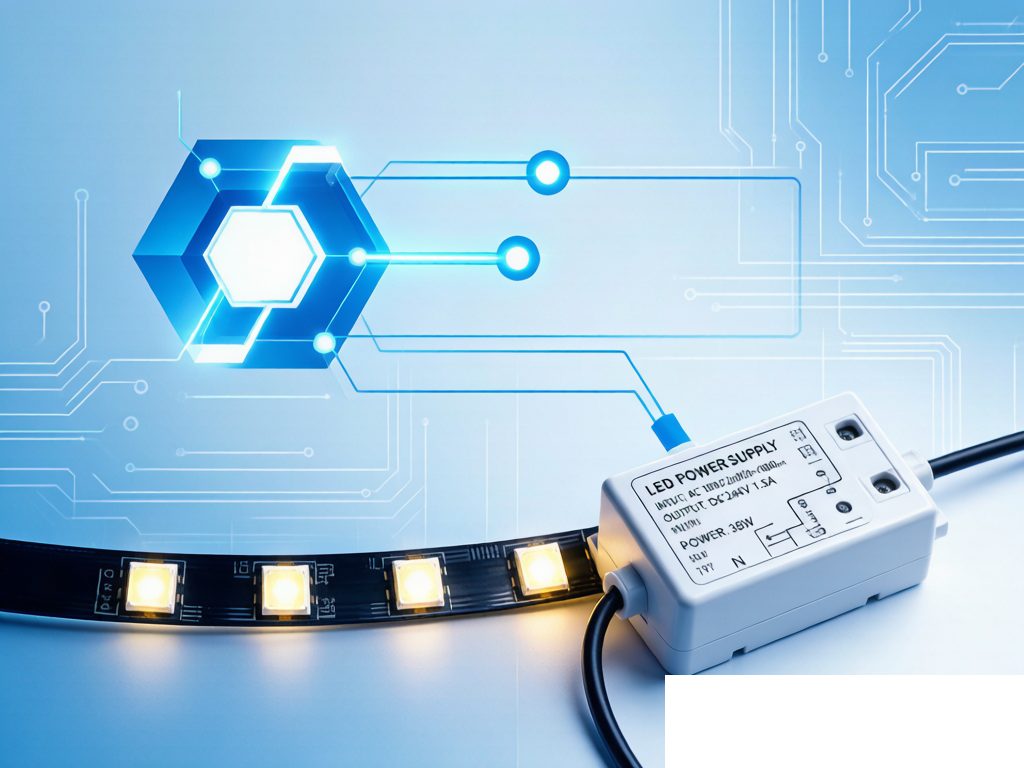
Choosing an LED power supply sounds technical, but it comes down to three things: wattage, IP rating, and input voltage. Get those three right and you have eliminated 90% of returns and field failures.
This guide walks through exactly what you need to check before ordering — written by our engineering team, not a marketing department.
Step 1: Match the Wattage
The most common mistake is undersizing. Here is the rule of thumb we use at CHUGAO:
Always leave at least 25% headroom. Running a driver at 100% capacity shortens its life and runs hotter.
Example
If your LED strip pulls 80W, do not buy an 80W driver. Buy a 100W unit (or larger). The extra capacity keeps output stable, reduces heat, and extends lifespan from ~3 years to 5+ years.
Why headroom matters
- Temperature: Drivers run cooler below rated load. Every 10°C reduction roughly doubles capacitor life.
- Surge tolerance: LED strips can draw brief spikes at startup. Headroom absorbs them without tripping protection.
- Voltage stability: A lightly loaded driver holds output voltage more tightly, which means more consistent brightness.
Step 2: Pick the Right IP Rating
The IP (Ingress Protection) code tells you how well the driver resists dust and water. This is where most projects go wrong — people save $2 on the driver and then replace it after one rainstorm.
| IP Rating | Dust | Water | Use Case |
|---|---|---|---|
| IP20 | No protection | No water protection | Indoor dry locations only |
| IP65 | Dust tight | Water jets (any direction) | Outdoor exposed, washdown areas |
| IP67 | Dust tight | Immersion up to 1m | Temporary submersion, flooding risk |
| IP68 | Dust tight | Continuous immersion | Underwater fixtures, deep submersion |
If you are not sure, go one step higher than you think you need. The cost difference between IP20 and IP65 on a 100W driver is typically under $3 at factory-direct pricing.
Step 3: Check Input Voltage Compatibility
This one is easy to overlook but causes the highest return rate:
- North America, Japan, Taiwan, China: 110V AC / 60Hz
- Europe, China, most of Asia, Africa: 220–240V AC / 50Hz
- Brazil: 127V/220V hybrid (check local outlet)
- Industrial / marine: Often 277V, 380V, or 480V 3-phase
Input ranges vary by line. Adapters cover 100–240V AC; indoor, IP65, and IP67 models cover 190–264V (IP67 up to 340V). Check the exact input range for your model in our Specs table and confirm it matches your destination grid voltage.
Quick Reference Checklist
- Add up total LED load watts → multiply by 1.25 → round up to nearest standard driver size.
- Check installation environment → indoor (IP20), outdoor/rainproof (IP65), or submersion-risk (IP67/IP68).
- Confirm destination country grid voltage → 110V region or 220V region.
- Optional: Do you need dimming? (0-10V, PWM, DALI, or Triac — specify when ordering)
- Optional: UL certification required? (adds cost, 2–3 weeks lead time per model)
Not sure which model fits?
Send us your specs — wattage, quantity, destination port, and target market. We reply within 1 hour during business hours with a datasheet and quote.
Request a Quote